Behavioral-health performance is rarely constrained by a lack of information anymore. After a decade of record digitization, claims integration, and analytics, most plans can describe their members in remarkable detail: who is rising in risk, who missed a refill, who left the hospital last night. Across the system, knowing has stopped being the hard part. Doing something about it, reliably and on time, has not.
We call the distance between the two the execution gap: the space between a correct, available insight and the coordinated action it is supposed to produce. In behavioral health, and nowhere more acutely than in Medi-Cal, that gap is exactly where value quietly leaks away.
The bottleneck kept moving
Healthcare's hardest problem has never sat still. Over three decades it migrated up the stack, and each wave of investment cleared the previous ceiling only to expose the one above it.
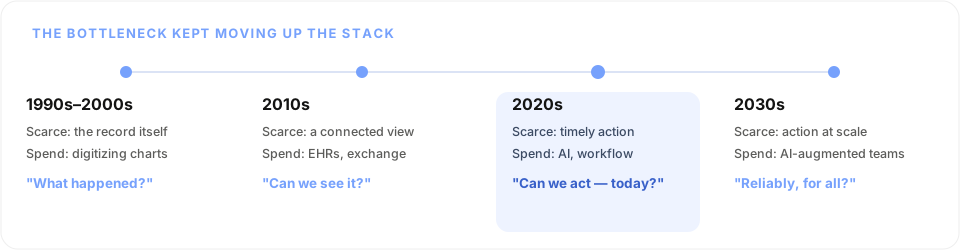
By 2021, 96 percent of U.S. acute-care hospitals ran a certified electronic record; by 2023, seven in ten exchanged information across all four interoperability functions: sending, finding, receiving, and integrating it [3][4]. The scarcity that justified two decades of spending, missing and siloed information, is largely solved. What replaced it is subtler and harder: turning a full picture into the right move, made in time.
Behavioral health is where the handoffs snap
If the unsolved problem is coordinated action, behavioral health is its most demanding test case. Medi-Cal is California's single largest purchaser of behavioral-health and addiction care [5], and nationally Medicaid covers nearly one in three nonelderly adults living with a mental illness [6]. When its coordination breaks, it breaks at scale. Consider a Medi-Cal member living with depression, a substance use disorder, and diabetes. Their care is split across three separately administered systems: a managed care plan for physical health, a county Mental Health Plan for specialty mental health, and the county Drug Medi-Cal system for addiction treatment [7]. Each system holds part of the record. No single entity owns the handoff end to end.
The seams show up as delay. When California's State Auditor examined children's behavioral health in 2023, it found that 43 percent of psychiatry providers could not offer an urgent child appointment within the 96-hour standard and 58 percent of urgent therapy appointments exceeded the 48-hour standard, with some waits stretching to roughly one hundred days, while children arrived at emergency departments in behavioral crisis about 83,000 times a year on average [8]. A 2024 JAMA secret-shopper audit of Medicaid psychiatric directories reached a live, bookable clinician in Los Angeles just 15 percent of the time, with a median wait of 64 days [9]. And after a psychiatric hospitalization, the moment follow-through matters most, only about four in ten Medicaid members are seen within a week [10].
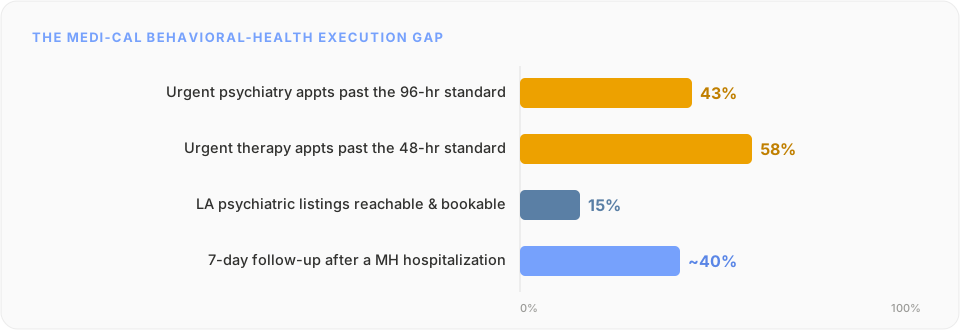
None of these numbers describe a shortage of insight. Behind nearly every missed window sat a complete record: a follow-up on file, an open referral, a risk score past its threshold. What failed was not the knowing but the finishing.
The gap has a price
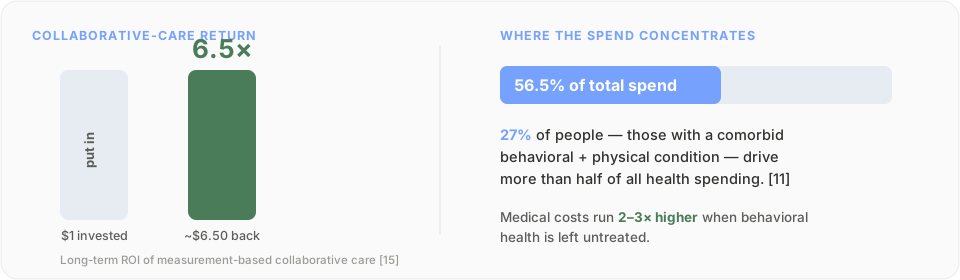
Unfinished coordination is not only a clinical failure; it is also a substantial and often under-measured cost driver. In a large claims analysis, the roughly 27 percent of people carrying both a behavioral and a physical condition accounted for 56.5 percent of total spending, with medical costs running two to three times higher than for comparable patients without a behavioral diagnosis [11]. That study drew on a commercial population; in Medicaid, where behavioral complexity concentrates, the pattern is if anything sharper. Every preventable behavioral-health emergency visit (roughly 520 dollars in facility cost before any downstream admission [12]) is usually a handoff that never closed.
A coordination problem won't yield to another dashboard
When results stall, a common response is to add another view: one more model, alert, or report. But past a point, more information makes the problem worse. The people meant to act on it are already stretched: physicians spend close to half of their day inside the record rather than with the patient [1], and even after a recent decline, roughly 42 percent still reported a burnout symptom in 2025 [2]. Every additional dashboard competes for the one resource a care team cannot buy more of: attention. When everything is surfaced, nothing is prioritized, and the single member who needed a call today disappears among ninety who could have waited. In a world of abundant signal, the scarce skill is deciding what to do first, and then making sure it actually gets done.
How Medera closes the gap
Medera is built for the constraint that actually binds. Rather than stacking another analytics layer onto an already-full screen, it runs as a coordination layer that carries a signal all the way to a completed action. The work happens in four stages, and the last one, closing the loop, is the step where workflows most often stop.
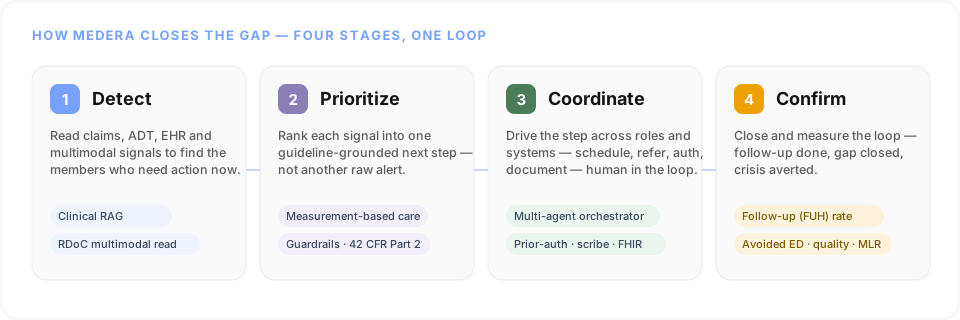
Every stage runs on a working Medera capability: multimodal clinical analysis grounded in neurophysiological and behavioral constructs, a multi-agent care orchestrator that moves work across roles and systems, prior-authorization and documentation agents that strip out administrative drag, and an EHR-agnostic scribe, all governed by HIPAA and 42 CFR Part 2 so that sensitive behavioral-health information moves only where consent allows. The goal is not a sharper picture of the population. It is a finished action for the member who needed one.
Why this compounds under value-based care
California is already rewiring behavioral-health payment around precisely this kind of follow-through. The BH-CONNECT demonstration, running 2025 through 2029, pairs a 1.9 billion dollar workforce fund with a separate 1.9 billion dollar incentive program that pays county behavioral-health plans for access and outcomes: the exact measures coordination moves [13]. The 2023 CalAIM payment reform had already shifted counties from cost-based reimbursement to a fee schedule, making timely, documented, coordinated care the unit that gets paid [14]. And the clinical case was settled years ago: measurement-based collaborative care, tested in more than ninety randomized trials, roughly doubles the odds of depression improvement and returns about 6.50 dollars for every dollar invested over time [15].
The evidence was never the obstacle. Executing the model, member by member, at Medi-Cal scale, always was, and that is a coordination problem, which is exactly what we build for.
A note on the numbers
The work ahead
Healthcare spent a generation learning to see. The harder and more valuable work now is learning to act: reliably, on time, for the members most likely to fall through. Most of what should happen tomorrow is already visible today: the follow-up that is due, the refill that lapsed, the discharge that needs a hand within the week. What remains unbuilt is ownership of the last step. That is the gap Medera exists to close, not by generating more to know, but by turning what a plan already knows into action that reaches the member.
References
- 1
Sinsky C, Colligan L, Li L, et al. Allocation of Physician Time in Ambulatory Practice: A Time and Motion Study in 4 Specialties. Annals of Internal Medicine. 2016;165(11):753–760. acpjournals.org
- 2
American Medical Association. Physician burnout rate continues decline, falling to nearly 42%. 2026. ama-assn.org
- 3
ASTP/ONC. Non-Federal Acute Care Hospital EHR Adoption (2021 data). HealthIT.gov. healthit.gov
- 4
ASTP/ONC. Interoperable Exchange of Patient Health Information Among U.S. Hospitals, 2023. HealthIT.gov. healthit.gov
- 5
California Department of Health Care Services. About DHCS; California Health Care Foundation, Medi-Cal Behavioral Health Services. dhcs.ca.gov
- 6
KFF. Medicaid, Mental Health, and Substance Use: Expansion Trends and the Fiscal Pressure Ahead. 2024. kff.org
- 7
DHCS. Specialty Mental Health Services and Drug Medi-Cal Organized Delivery System (DMC-ODS). dhcs.ca.gov
- 8
California State Auditor. Children's Mental Health: Report 2023-115. December 2023. auditor.ca.gov
- 9
Brahmbhatt DH, Schpero WL. Availability of Psychiatric Care Among Medicaid Managed Care Plans. JAMA. 2024. jamanetwork.com
- 10
National Committee for Quality Assurance. HEDIS: Follow-Up After Hospitalization for Mental Illness (FUH), Medicaid (approximate benchmark). ncqa.org
- 11
Milliman / The Path Forward. Potential Economic Impact of Integrated Medical-Behavioral Healthcare (commercial claims). 2020. thekennedyforum.org
- 12
AHRQ HCUP. ED Visits Involving Mental and Substance Use Disorders, 2017. ncbi.nlm.nih.gov
- 13
DHCS. BH-CONNECT Section 1115 Demonstration (Jan 1, 2025 – Dec 31, 2029). dhcs.ca.gov
- 14
DHCS. CalAIM Behavioral Health Payment Reform (effective July 1, 2023). dhcs.ca.gov
- 15
Unützer J, et al. Long-Term Cost Effects of Collaborative Care for Late-Life Depression. Am J Manag Care. 2008. Evidence base summarized by the AIMS Center, University of Washington. aims.uw.edu