The biomarker inference layer for mental health.
Measure vocal, physiological, facial and clinical-context biomarkers, compare each person with their own baseline, and get calibrated evidence back through one API.
For research and clinician review. Not a diagnosis.
Trust is the
treatment plan.




Four signals. One contract.
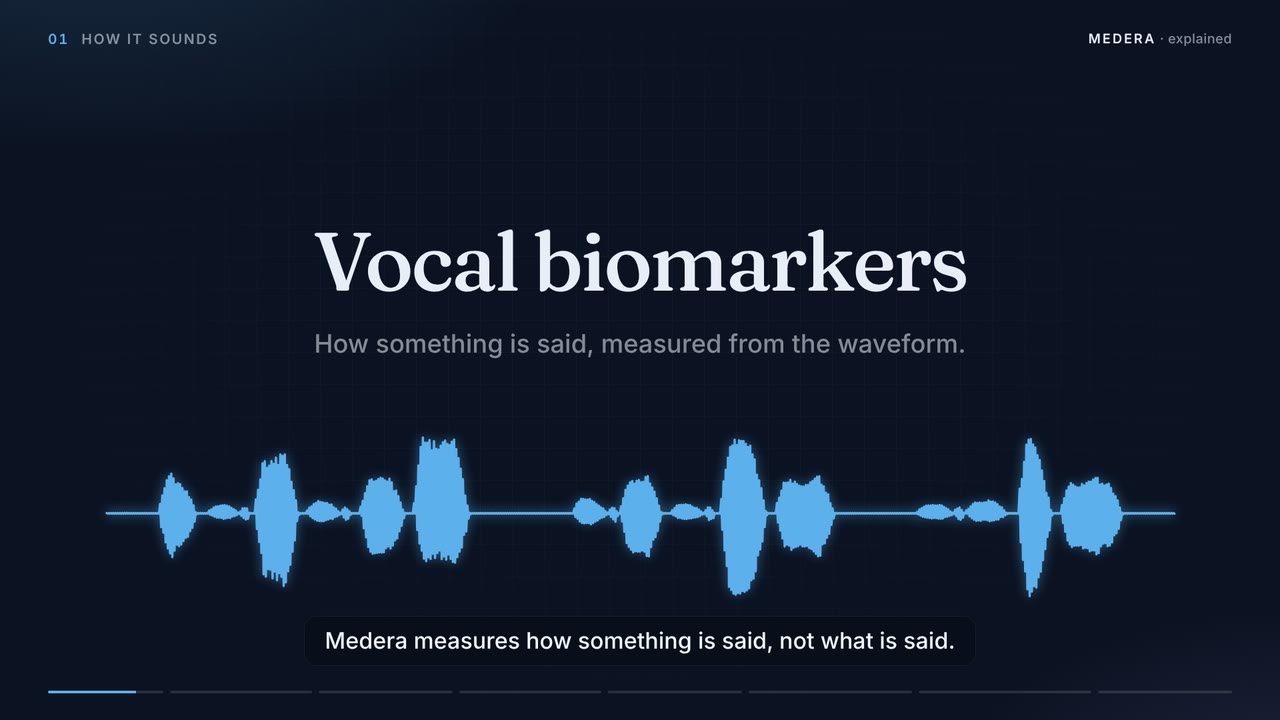
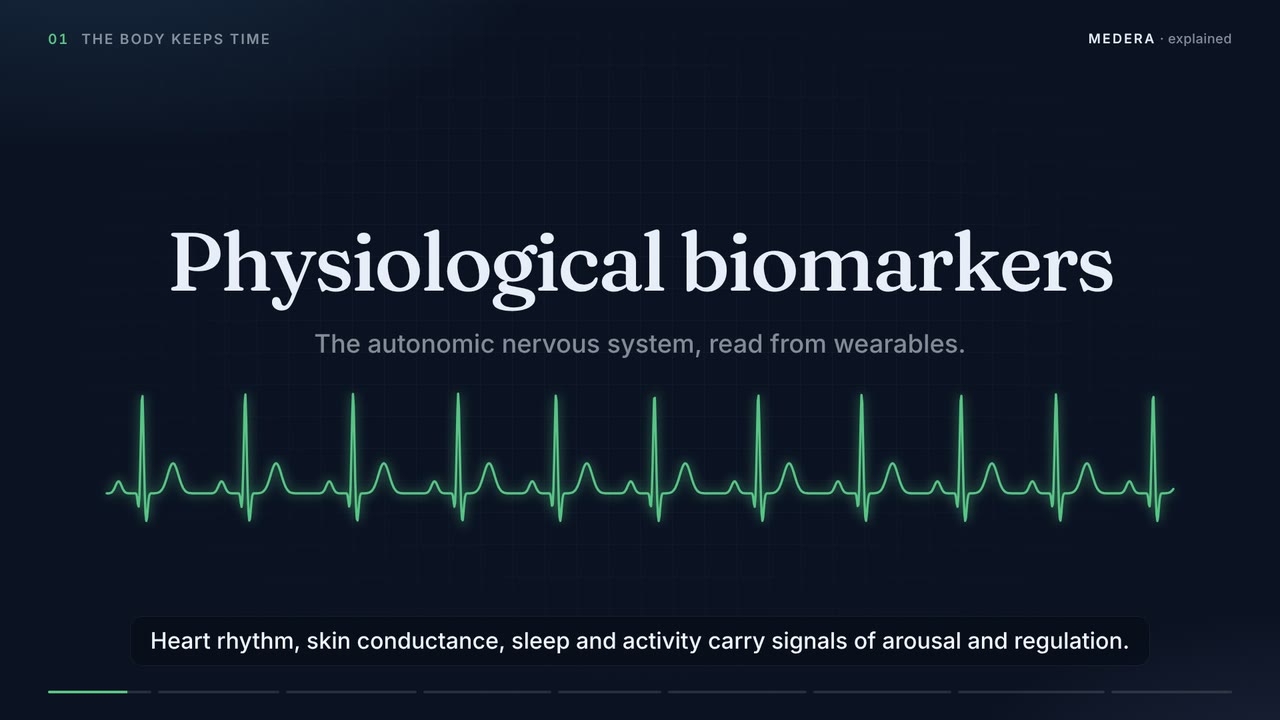
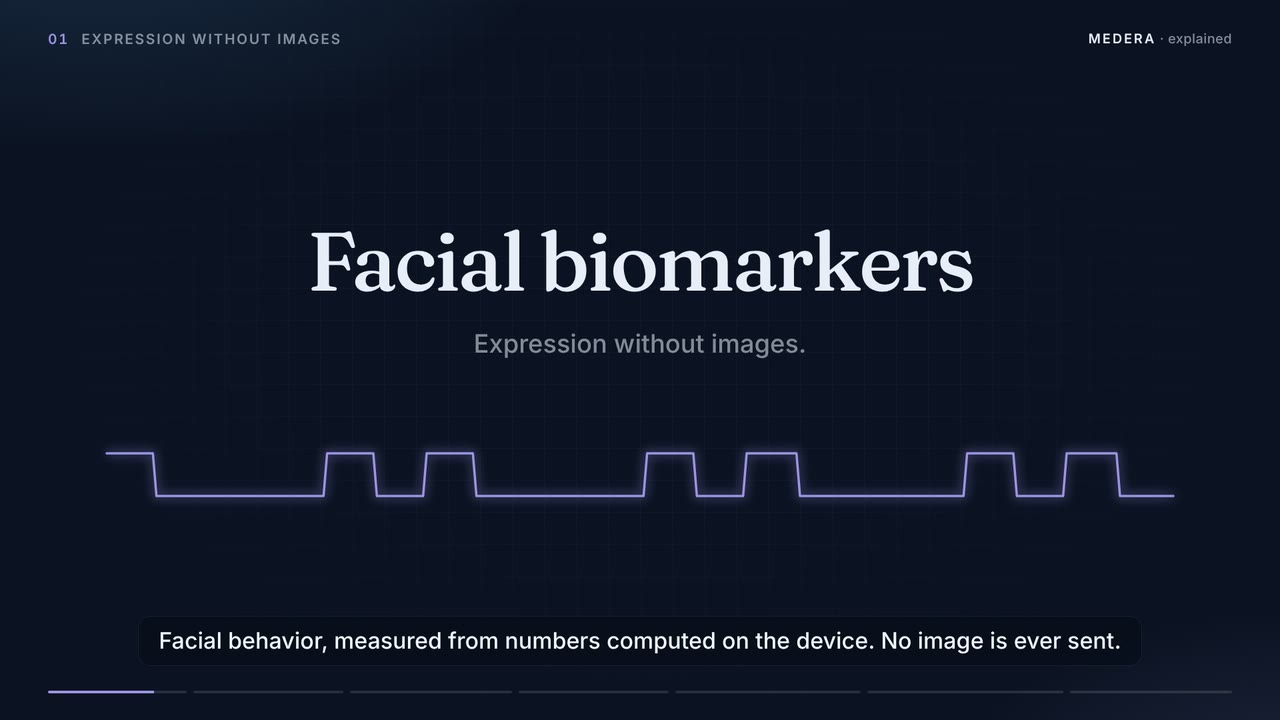
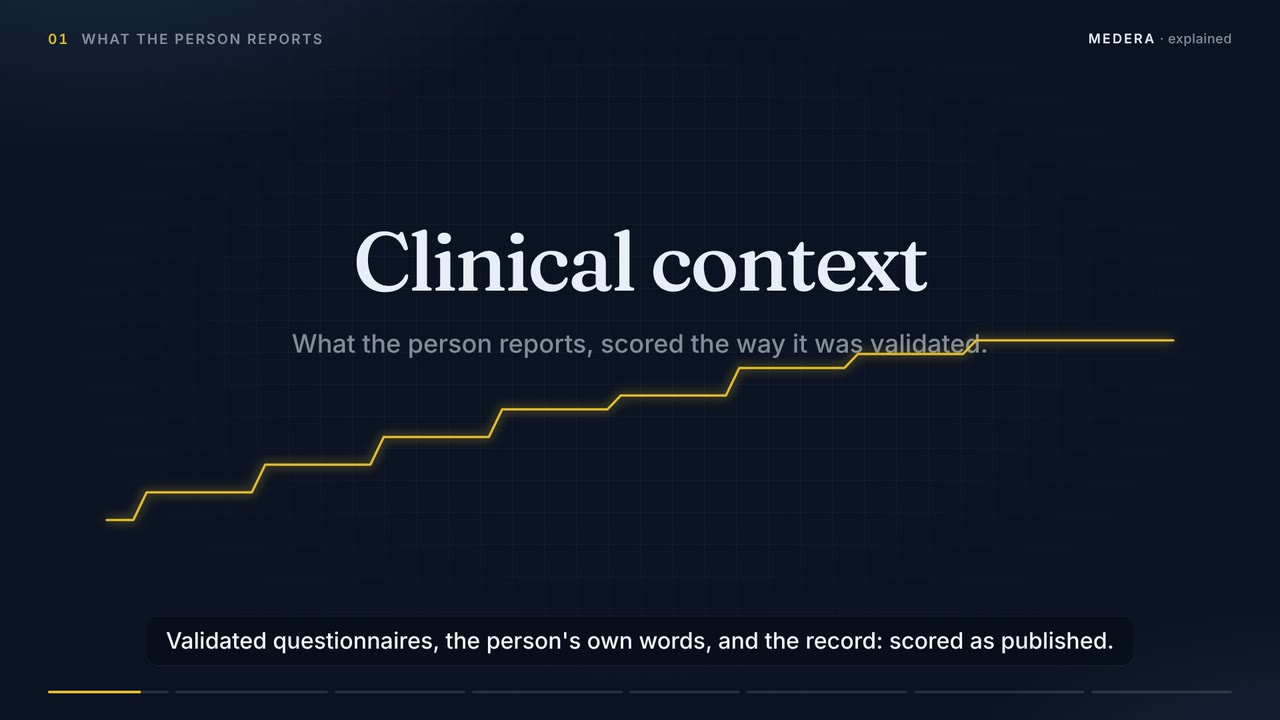
Each modality has its own endpoint, its own quality gates and the same response shape. Send one, or all four in a single call.
Measure. Compare. Weigh.
Three steps, each with a published method behind it and a stated limit on what it can claim.
Measure
Send audio, wearable series, on-device face scores or questionnaire answers. Each modality returns its biomarkers, each one gated: a value the data cannot support comes back null with the reason.
The four modalitiesCompare
The engine reads every biomarker against the same person's earlier sessions, pools deviations by RDoC domain and flags change at a stated error rate, with conformal p-values once there are enough sessions.
How change is testedWeigh
Validated instruments move a setting prior to a post-test probability with published likelihood ratios. Risk items route to a clinician whatever the numbers say. A clinician decides.
How evidence is weighed# The published sample request (synthetic, no real person's data)
curl -s https://www.medera.info/api/v1/samples/analyze -o analyze.json
curl -s https://www.medera.info/api/v1/analyze \
-H "Authorization: Bearer mk_sandbox_medera_public" \
-H "Content-Type: application/json" \
--data @analyze.jsonWhat comes back for the sample
- Tier
- review
- Change method
- conformal, 24 baseline sessions
- Strongest domain
- Social processes, p 0.04
- Major depression
- 28.25% post-test, prior 11.92%
- Safety
- routine, no risk item
The engine's own output for the /v1/analyze sample: synthetic physiological, facial and clinical-context inputs against 24 weekly sessions. Every number on this site comes from a published sample.
Compare a person with themselves.
A population cutoff mistakes a quiet voice for a symptom. The engine asks a better question: is this person different from their own history, and how sure can we be?
Within-person
Every biomarker against the same person's earlier sessions, read in the direction the literature associates with burden.
Conformal
With 19 or more sessions, today's score is ranked among every session's: a p-value with no distributional assumption.
Evidence, stated
Post-test probabilities show their prior, likelihood ratio and source. Safety items escalate regardless.
Five short films. No hand-waving.
Each one walks through a modality or the engine, step by step, with the real numbers for a published sample.
Built like infrastructure.
A small, strict API that behaves the same way every time, and says exactly why when it cannot answer.
A public sandbox
One shared key, every endpoint, synthetic samples to send. No sign-up to make a first request.
OpenAPI 3.1
The contract is generated from the same schemas that validate every request.
Problem details
Errors follow RFC 9457, with a code, the exact field path and a request ID.
Zero retention
Bodies are processed in memory and discarded. Logs hold method, path, status and timing only.
Versioned
Everything lives under /v1. Breaking changes ship as a new version, never in place.
Deterministic
The same request returns the same numbers, so results can be reproduced and audited.
Measured, never generated. Clinicians decide.
The commitments every endpoint keeps, whatever the request.
Measured, never generated
Every value comes from a published, deterministic method. The same input returns the same output, and nothing is written by a language model.
Within-person by design
Voice, physiology and expression differ between people and setups. The engine compares a person with their own history, never with a population cutoff.
Null over a guess
Each measure has a quality gate. When the data cannot support a value, the API returns null and names the reason.
Error rates stated
Change is flagged at a stated alpha, with conformal p-values once there are enough sessions and false discoveries controlled across domains.
Safety reaches a clinician
A positive PHQ-9 item 9 or any C-SSRS risk escalates the result, whatever the probabilities say. No setting turns that off.
Nothing is stored
Requests are processed in memory and discarded when the response is sent. You hold the baseline; it travels with each request.
Measurement-based care, digital programs, research and remote monitoring.
Questions, answered.
Still wondering about something?
A real person will answer, usually the same day.
No. Medera measures biomarkers and reports within-person change and condition evidence for research and for clinician review. It is not a medical device and it does not diagnose; a clinician decides.
Nothing. Audio, series, scores and answers are processed in memory and discarded when the response is sent. Logs carry the method, path, status, latency and request ID only.
Yes. The public sandbox key works on every endpoint with synthetic data, at 30 requests a minute, and every endpoint has a downloadable sample request. Live keys for real data are issued under agreement, with a BAA.
Any combination. Each modality has its own endpoint, and /v1/analyze takes whatever you have in one call. The engine compares whichever biomarkers you send with the same person's earlier sessions.
From validated instruments. Published likelihood ratios move a setting-specific prior to a post-test probability, and every result shows its prior, likelihood ratio, derivation and source.
Medera is HIPAA compliant: we sign a Business Associate Agreement before any PHI moves, every request travels over TLS, and no request content is stored. Our SOC 2 Type II report is available under NDA.
Start measuring.
Sandbox today. Production under agreement.
Or make a first request with the sandbox key.